Magnetic mystery in thorium clusters resolved by new study
Researchers have shown that unusual thorium clusters respond to magnetic fields in a fundamentally different way than expected, helping to explain a long-running disagreement between experiments and computer models.
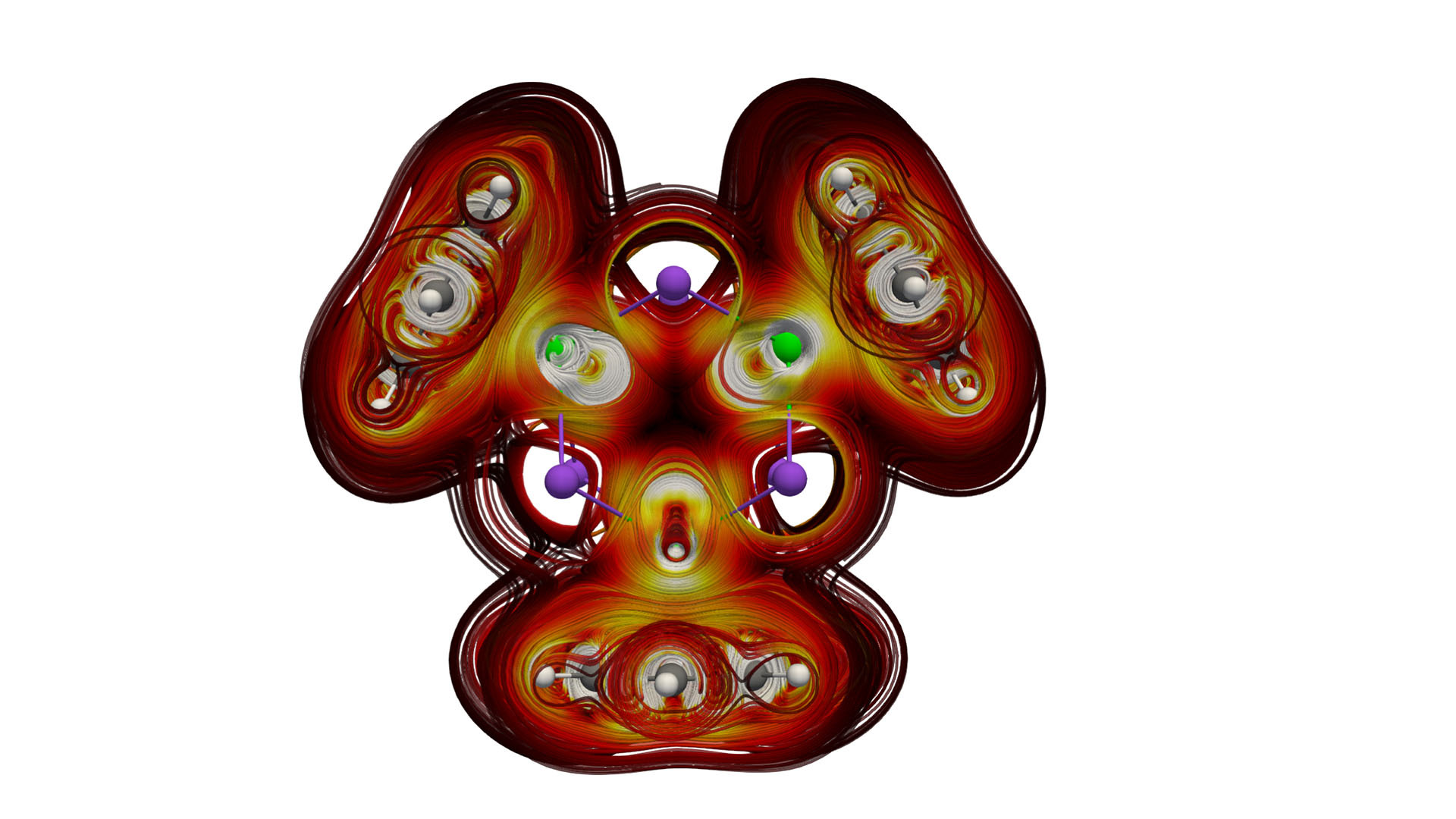
Scientists from 糖心Vlog官方鈥檚 Department of Chemistry, Centre for Radiochemistry Research, and the Photon Science Institute, led by , have uncovered why a rare class of metal clusters appears to behave differently in experiments and theoretical calculations, resolving a debate about the nature of chemical aromaticity and revealing a previously overlooked type of magnetic response.
The study, published in , examined clusters made from three thorium atoms and found that they display an unusual field-induced magnetic behaviour. The discovery helps explain conflicting interpretations of these materials and could improve how chemists assess aromaticity in metal-based systems.
A long-running debate about metal aromaticity
Aromaticity is a fundamental concept in chemistry that helps explain the stability and behaviour of molecules. While it is traditionally associated with carbon-containing compounds such as benzene, researchers have recently discovered forms of aromaticity in all-metal systems. One such example involves clusters of three thorium atoms that had previously been reported to show signs of so-called Jellium aromaticity, a form of electron delocalisation found in metal clusters.
However, those earlier findings sparked debate because experimental measurements suggested the clusters were aromatic, while some computational studies argued otherwise. To investigate the disagreement, researchers synthesised and characterised an expanded family of one-electron and two-electron trithorium clusters and compared their magnetic behaviour with that of conventional organic aromatic compounds.

Aromaticity is one of the most important concepts in chemistry because it helps us understand why certain molecules behave the way they do. Our results suggest that chemists need to be careful when using ring current calculations alone to assess aromaticity in metal systems. The magnetic response of these compounds is more complex than expected, and understanding that behaviour gives us a clearer picture of chemical bonding in some of the most unusual compounds known.
An unexpected magnetic response
Using a combination of synthesis, spectroscopy, electrochemistry, crystallography, magnetic measurements and quantum chemical calculations, the team found that all of the thorium clusters exhibited unusually strong diamagnetism, a magnetic signature associated with aromatic behaviour. This was true for both open-shell and closed-shell systems, demonstrating that all the clusters behaved as aromatic "superatoms".
The researchers also observed something unexpected. Instead of responding immediately and linearly to an applied magnetic field, the thorium clusters initially showed a weak paramagnetic response before switching to strong diamagnetism as the field increased. By contrast, familiar organic aromatic molecules including benzene, naphthalene and anthracene displayed the expected linear response from near zero field.
The findings suggest that electrons in the thorium clusters must first reorganise under the influence of an external magnetic field before establishing the coherent electronic motion responsible for aromaticity. According to the authors, this behaviour helps explain why some computational methods, which assume a linear response, have produced conflicting conclusions about whether the clusters are aromatic.
The work highlights an important distinction between classical organic aromaticity and emerging forms of all-metal aromaticity. While organic aromatic systems appear to be naturally arranged to sustain aromatic currents, the thorium clusters seem to require an external field to trigger the electronic reorganisation needed to produce the same effect.
This work helps reconcile experimental observations with theoretical predictions and provides new insight into how aromaticity can emerge in all-metal systems. It also highlights the importance of combining experimental measurements with computational analysis when studying complex compounds containing heavy elements.
The researchers say the study demonstrates the need for caution when using magnetic current calculations alone to assign aromatic character, particularly in systems containing heavy metals where non-linear magnetic responses may be more common than previously recognised. The findings could help researchers better understand bonding in complex metal systems and refine future approaches for evaluating aromaticity.
This research was published in: Nature Communications
Full title of the paper: Field-induced non-linear magnetic responses of all-metal Jellium 蟽-aromats
DOI: 10.1038/s41467-026-74403-3
URL: