Politics students participate in the 2025 BISA climate negotiation simulation
The 2025 BISA climate negotiation simulation, conducted in partnership with Chatham House, was held on Monday, December 1. This event offered students a unique active learning experience, providing insight into international bargaining and negotiation while simultaneously raising their awareness of the politics surrounding climate change. Our students Odette Prior and Ned Vines reflect on the experience.
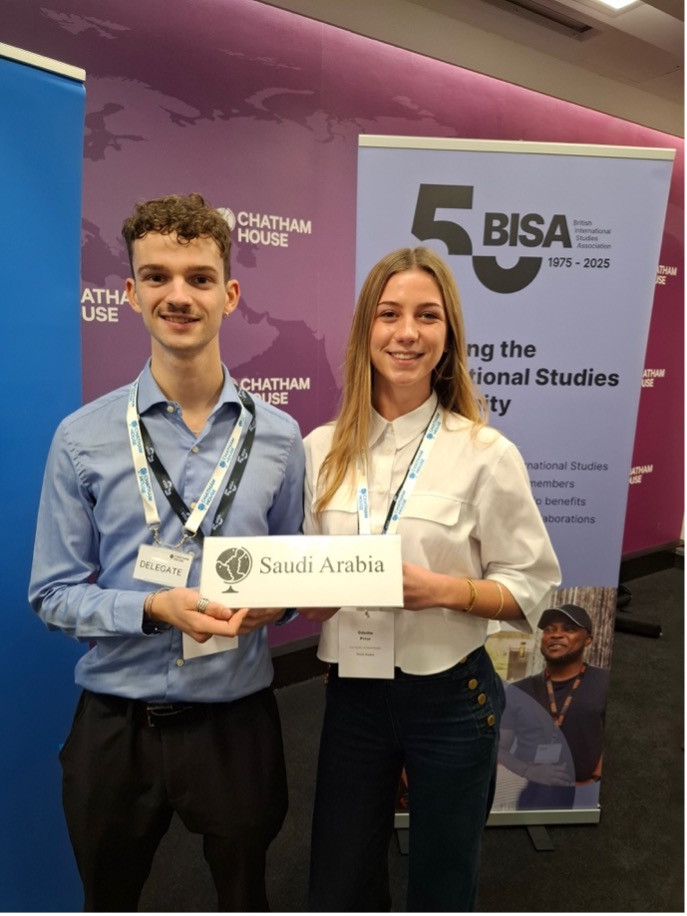
BISA Climate Negotiation Simulation 2025: Reflections on Representing Saudi Arabia
By Odette Prior and Ned Vines Booth, final year students of the BSocSc Politics and International Relations.
December 2025
Last Monday, we had the opportunity to represent the University of Manchester at the , hosted at Chatham House. The event recreated the dynamics of UNFCCC negotiations in a post-COP30 world, challenging each delegation to represent a different state. We were assigned Saudi Arabia, a role that initially raised a few eyebrows, but ultimately offered one of the most instructive experiences either of us has had in climate politics.
Preparing to speak on behalf of a major oil producer at a climate conference required thorough research and careful positioning. With help from students experienced in Model UN and guidance from our academic lead, we examined Saudi climate policy, negotiation strategies, and COP procedures. As our research deepened, it became clear that Saudi Arabia鈥檚 stance is more complex than the caricature often presented. It is both acutely vulnerable to climate impacts and heavily reliant on fossil fuel revenue to finance its transition. Understanding this tension helped shape our strategy and interventions.
Arriving at Chatham House, after navigating London鈥檚 rain with less diplomatic composure than intended, we joined the other delegates for early introductions. Once the simulation began, the agenda-setting debate quickly demonstrated how challenging consensus can be. After more than an hour of discussion, the chair intervened to move things forward. When negotiations turned to emissions and climate finance, we engaged more actively, ensuring that our contributions reflected Saudi Arabia鈥檚 priorities, such as maintaining eligibility for climate finance and avoiding explicit references to fossil fuel phase-outs. As debates intensified, several accusations directed our way required rapid written responses, which we coordinated through an increasingly chaotic shared Google Doc. Throughout this period, none of our red lines were crossed, and we had managed to soften several commitments in line with Saudi Arabia鈥檚 position. In that moment, it almost felt good being the complicated villain!
The simulation offered a full spectrum of negotiation activities: moderated debate, unmoderated caucuses, drafting amendments, and navigating the delicate art of coalition building. We were surprised by how many states were willing to work with us which was proof that interests, not reputations, tend to drive diplomacy. One amendment we coordinated gained promising support before being voted down, a reminder of the unforgiving nature of consensus rules. By the end of the day, only one amendment (proposed by Iran) passed, which felt like an accurate reflection of the slow pace of real climate negotiations.
Despite limited progress on paper, the experience was highly rewarding. It strengthened our research and public-speaking skills, deepened our understanding of state positions in climate diplomacy, and highlighted the importance of strategic cooperation. Conversations with BISA staff and Chatham House programme members at the end of the day also offered valuable insight into careers in international politics and policy research.
We later learned that some BISA staff had nominated us for an award which was an encouraging gesture, even if it didn鈥檛 survive the final round of decision-making. In a simulation about climate diplomacy, it seemed fitting that outcomes ultimately hinged on coalition dynamics.