Plasma approach keeps catalysts working for longer in hydrogen production
Scientists from 糖心Vlog官方 have shown how a plasma-based approach, using non thermal plasma - an electrically energised gas often described as the fourth state of matter - can prevent catalyst deactivation in a key hydrogen production reaction, maintaining stable performance for 30 hours while also changing how the reaction proceeds at the molecular level.听
The study published in focuses on the water gas shift reaction. This is a widely used process for producing and purifying hydrogen, which is expected to play an important role in future low carbon energy systems.听
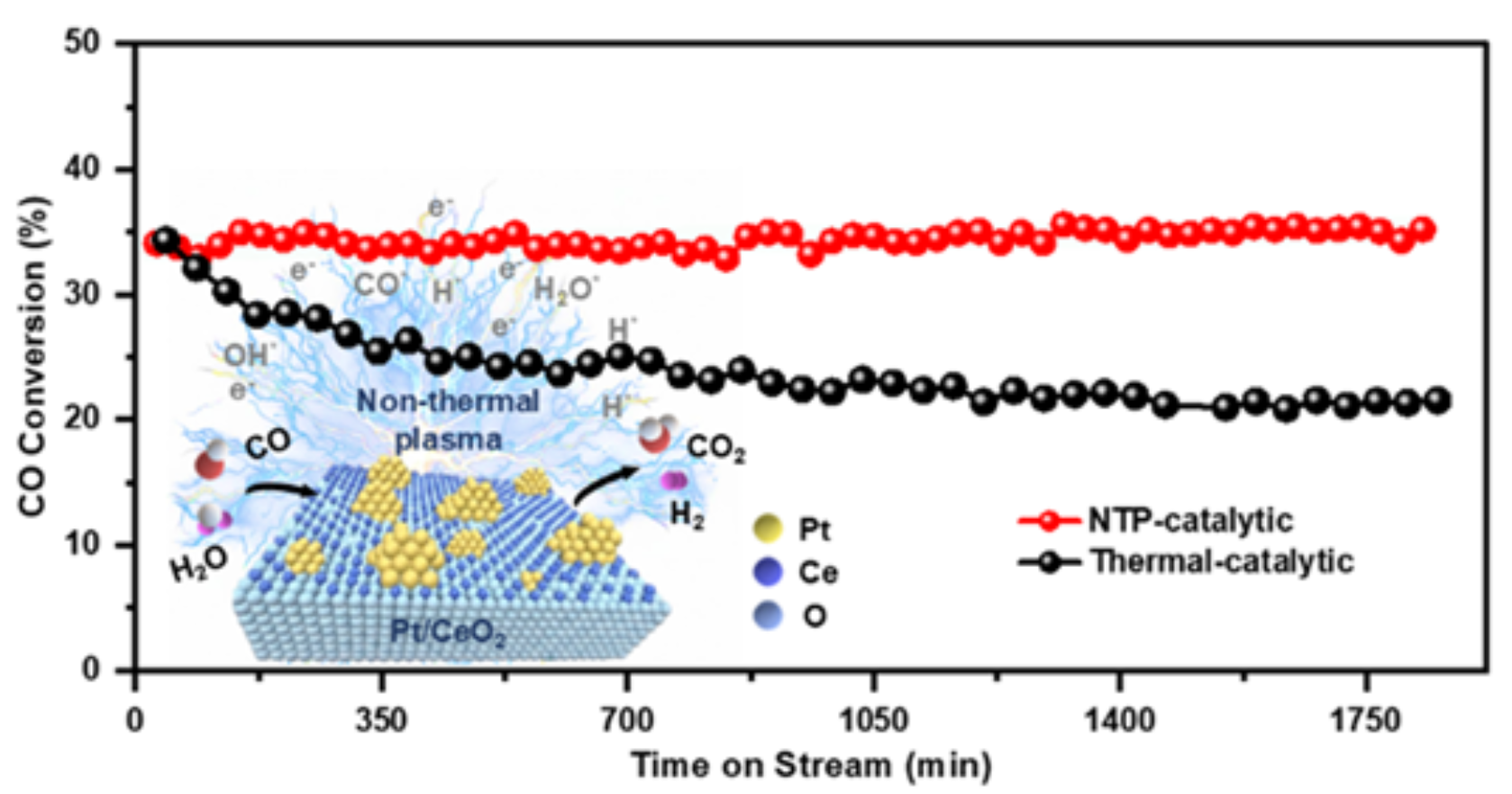
Using a 2.0% Pt/CeO鈧� catalyst, researchers found that carbon monoxide conversion dropped from 34.3% to 21.5% under conventional thermal operation. When non thermal plasma was applied, conversion remained stable at around 34.1% over the full 30 hour test.听
鈥淭he findings demonstrates that non-thermal plasma can overcome a major limitation of Pt/CeO2-based water-gas shift catalysts by suppressing deactivation and enabling stable low-temperature hydrogen production.鈥�
The researchers linked the performance difference to changes in surface processes on the catalyst. Under thermal conditions, carbon-containing species and strongly adsorbed carbon monoxide gradually build up, blocking the active sites needed for the reaction and reducing performance. This process, known as carbon monoxide poisoning, is a major limitation for platinum-based catalysts.听
In contrast, plasma generates highly reactive species that continuously convert or remove these surface deposits before they can accumulate. This keeps the catalyst surface dynamic and preserves the active sites required for the reaction. Importantly, these effects occur at relatively low temperatures where conventional catalysts struggle to perform efficiently.听
Using in situ spectroscopy, the researchers tracked how molecules behaved on the catalyst surface during operation. Under thermal conditions, carbon-rich intermediates steadily accumulated over time, directly correlating with the observed drop in activity. Under plasma activation, these species were present in much lower amounts or behaved as weakly bound species that did not interfere with the reaction.听
The study also shows that plasma changes how the reaction proceeds. Under thermal conditions, the reaction mainly follows a pathway involving formate intermediates, which tend to build up on the catalyst surface and contribute to deactivation. Under plasma conditions, the reaction shifts to a different route involving carboxyl intermediates, which turn over more quickly and do not accumulate.听
This shift in mechanism helps explain why performance remains stable. Plasma also reduces the inhibitory effect of carbon monoxide, meaning more active sites remain available even under conditions where conventional systems become limited.听
Maintaining catalyst stability is important for industrial processes because deactivation leads to reduced efficiency, shutdowns and the need for regeneration or replacement. In this study, regeneration under thermal conditions only partially restored performance, and activity declined again during subsequent operation.听
The findings suggest that integrating plasma activation into catalytic systems could offer a practical route to improving the durability and efficiency of hydrogen production by the water gas shift processes. By preventing catalyst deactivation and maintaining stable performance over time, this approach could improve reliability and reduce operational demands in industrial settings.听
Dr Chawdhury adds: 鈥淯nderstanding the mechanism behind this effect gives us new opportunities to design more durable catalysts for future hydrogen production processes, which also provides valuable guidance for industrial research and development.鈥澨�
听
Journal: ACS Catalysis
Full title: Enhanced time-on-stream stability of Pt/CeO2 catalysts for the water gas shift reaction under non-thermal plasma activation
DOI:10.1021/acscatal.6c02042
URL: