Look Back: The Past, Present and Future of the Computer in Electronic Music
On 25 March, Creative Manchester hosted a research café exploring Manchester’s role in the development of electronic music, from the earliest computers through to present advances in human-machine collaboration.
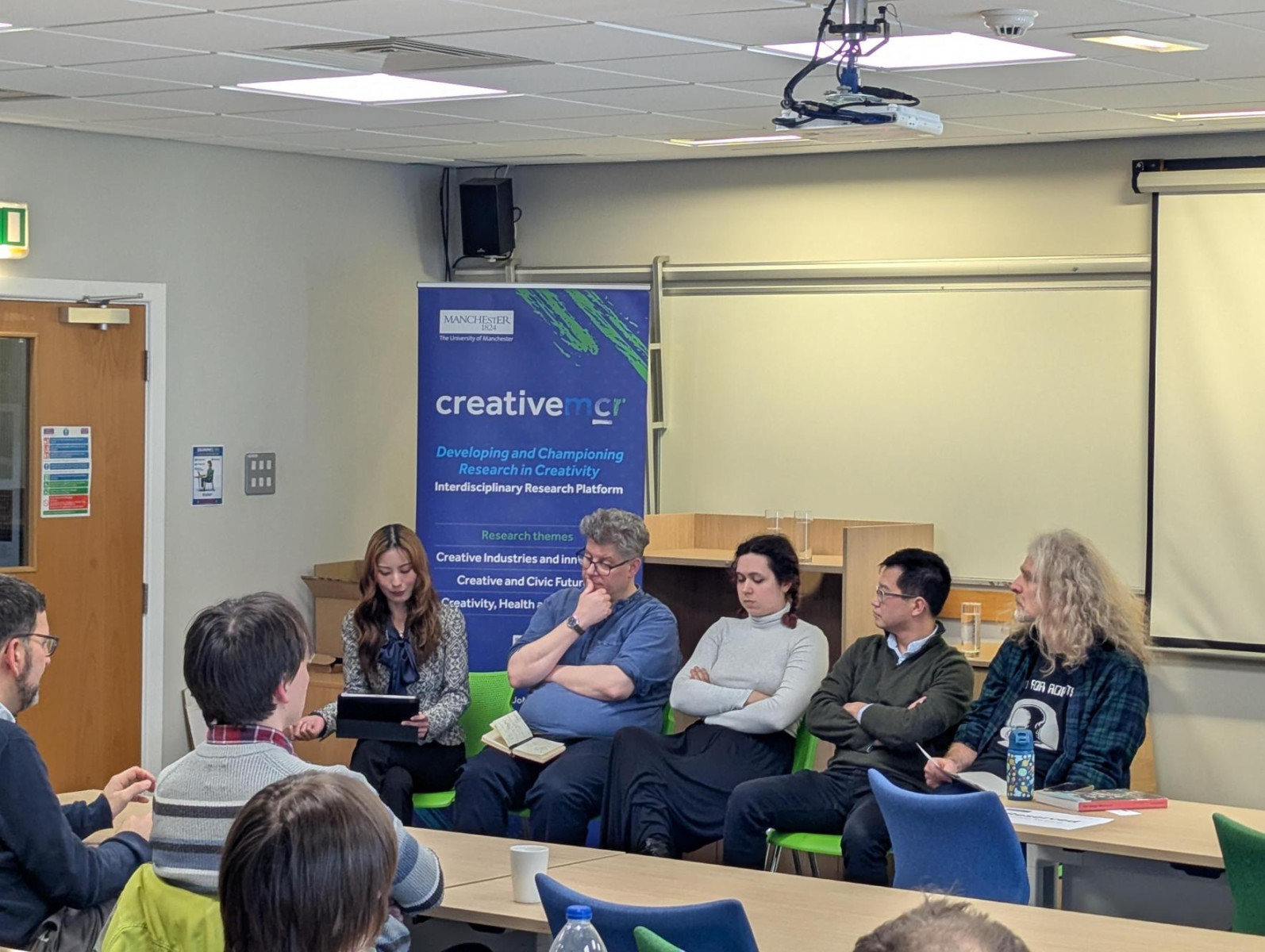
On 25 March, Creative Manchester hosted a research café exploring Manchester’s role in the development of electronic music, from the earliest computers through to present advances in human-machine collaboration.
Organised with help from the ,&²Ô²ú²õ±è;‘ addressed the city’s contributions to electronic music from an interdisciplinary perspective. The event explored the themes in computer science, musical composition and history, and asked what Manchester’s past can tell us about the future of machine‑assisted creativity.
Manchester’s influence on popular music has long been celebrated, with bands such as Oasis, The Smiths and Joy Division/New Order cementing the city’s reputation. Furthermore, Manchester’s contributions to computing are well known, with the University of Manchester celebrating 75 years since the development of the Turing Test this academic year. However, far less attention has been afforded to the intersection of these two histories, the city’s contributions to electronic music.
The event addressed three main components of this musical relationship: the early development of electronic music and Turing's work in Manchester; electronic music facilities and research at ÌÇÐÄVlog¹Ù·½ throughout the years; and contemporary human-machine collaborations shaping the future of electronic music.
The event began with a welcome address by Creative Manchester Director, Professor John McAuliffe, before (Senior Lecturer in Text Mining and Creative Manchester Theme Lead for Creative Industries and Innovation/CreaTech) introduced the aims and speakers for the day.
The first lightning talk was delivered by , a former mathematical biologist and author of Alan Turing’s Manchester. Dr Swinton highlighted that Turing himself was not especially interested in musical composition. Instead, it was the need to market computers that encouraged early experiments in using machines for entertainment. While Turing did not compose electronic music, contemporaries such as Christopher Strachey were instrumental in developing some of the earliest computer-generated works.
(Research Software Engineer, Centre for Interdisciplinary Methodologies, University of Warwick) then turned to the representation of sound in computing, drawing on the archive of Eric Sunderland, a maintenance engineer on Manchester’s Atlas machine who created polyphonic music using the computer. Dr Emsley highlighted the challenges of researching such archives, which are often incomplete: while numerical data survives, the sounds and voices those numbers once represented are frequently lost.
Manchester’s electroacoustic heritage was explored further by (Professor of Electroacoustic Music Composition and Director of the Electroacoustic Music Studios and MANTIS). Professor Berezan traced the history of the University’s electroacoustic studios, founded in 1967, from sparse archival records in the 1980s through a period of rebirth from the early 1990s to the present. These developments led to the founding of the and the in 2007, with a strong emphasis on taking electronic music out of the studio and into live performance.
Subsequently, (Professor of Innovation and Sustainability, ÌÇÐÄVlog¹Ù·½; Professor of Political Economy of Sustainability, Maastricht University) reflected on his personal journey with electronic music. Drawing on Zen Buddhist teachings from ShunryÅ« Suzuki, he described a ‘second beginning’ with music later in life. Professor Boons considered the concept of the ‘musical centaur’, a human musician assisted by a machine, alongside the risk of ‘reverse musical centaurs’, where humans become appendages of uncaring machines.
The final lightning talk was delivered by (Bicentenary Fellow in Music), who offered a glimpse into the future of machine involvement in music. Discussing her research project , an immersive opera with live audience interaction, Dr Huang-Kokina explored the artistic and technical challenges of integrating AI into performance. She also previewed her forthcoming project, ‘Emotion Engine’, which creates a real-time feedback loop between audience response and stage design, concluding with the question: “If the stage can finally listen, what will audiences say?� Dr Huang-Kokina’s work will be further discussed at the forthcoming research café, , on 19 May 2026.
Following the lightning talks, a panel discussion featuring Dr Alexandra Huang-Kokina, Dr Iain Emsley, (Professor of Natural Language Processing) and (Professor of Electronic and Produced Music at the Guildhall School of Music and Drama) and chaired by (Professor, Department of Computer Science). The panellists discussed what the role of machines should be in music production.
Following the event, attendees were invited to view Turing – Machine, a sound installation by Professor Frank Boons that articulates the evolving ways in which humans and computers interact, and an interactive two-player musical Turing test by PhD student .
To stay informed about Creative Manchester’s work in the Creative Industries and Innovation/CreaTech theme, as well as our other events and activities, please .