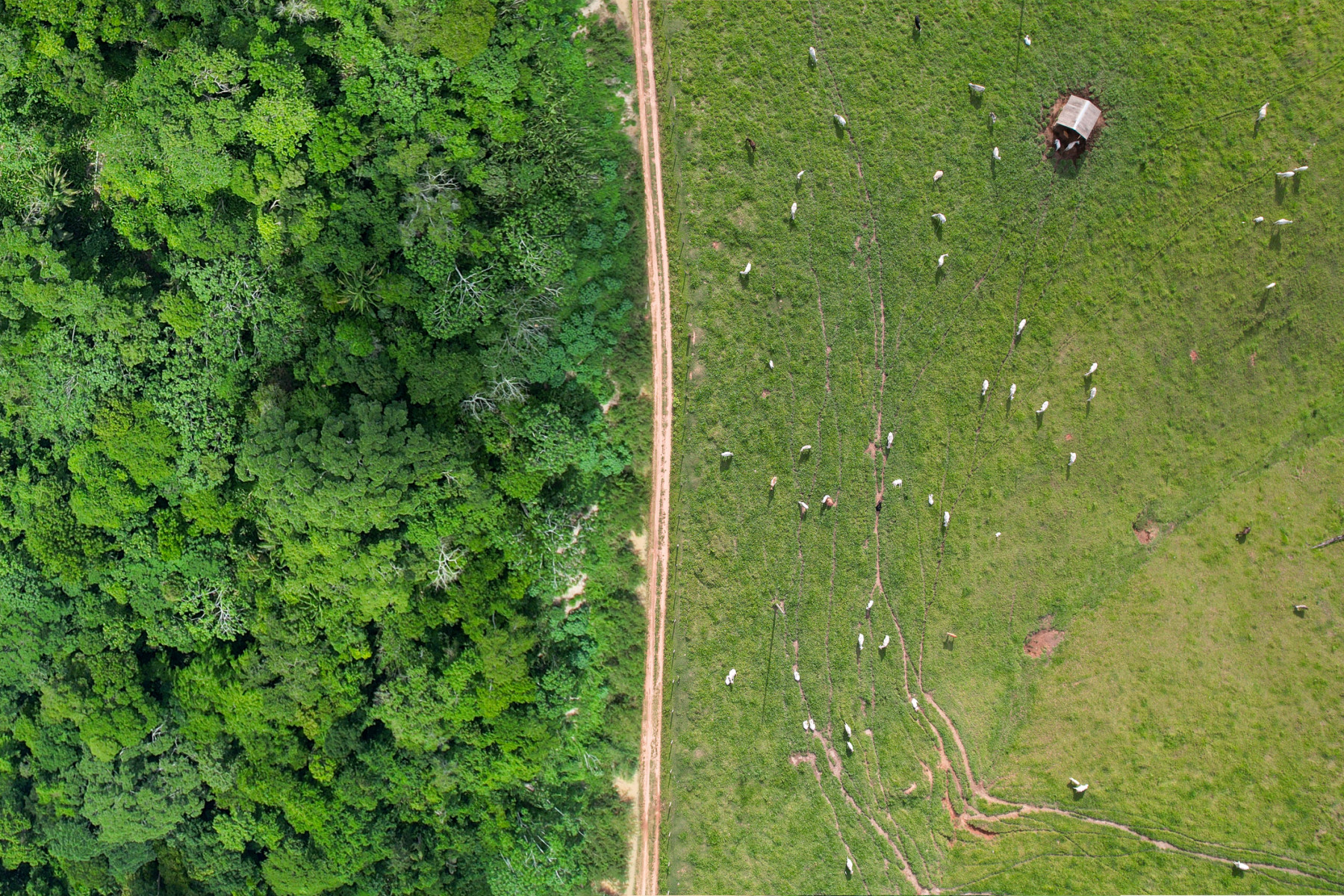
Global appetite for beef is driving Amazon deforestation, new study finds
A major international study involving researchers from 糖心Vlog官方 has found that rising global demand for beef is a key force behind deforestation in the Amazon rainforest.
The research shows how consumer demand in countries around the world is directly linked to land clearing in Brazil, often through complex supply chains that are difficult to regulate. By combining economic and environmental analysis, the study reveals why current efforts to curb deforestation are struggling to keep pace with global demand.
Key findings
- Growing global demand for beef is a major driver of deforestation in the Amazon
- Up to 80% of cleared forest land is converted into cattle pasture
- Higher land values after deforestation create strong financial incentives to clear forests
- Gaps in supply chain oversight allow deforestation to continue
- New framework identifies where interventions could have the greatest impact
What did the study find?
The research focuses on the Brazilian Amazon, where cattle farming is a leading cause of deforestation. It shows that decisions made by farmers are shaped by a powerful mix of global market demand, land prices and government policies.听
In many cases, clearing forest actually increases land value, creating a cycle where deforestation leads to profit 鈥� and to more deforestation. At the same time, environmental rules and sustainability initiatives often fail to fully reach the people making land-use decisions on the ground.听
Why does this matter to people?
Although the Amazon may feel far away, the study highlights how everyday consumption is connected to environmental change. Beef sold around the world in supermarkets and restaurants can be linked back to land-use decisions in the rainforest.听
The consequences are global. The Amazon plays a vital role in storing carbon and regulating the climate. As forests are cleared, this contributes to climate change, biodiversity loss and more extreme weather patterns worldwide.
What makes this study different?
Most research looks either at economic systems or environmental systems, but rarely both together. This study introduces a new approach that connects global supply chains with local ecosystems, showing how they influence each other in real time. It reveals that environmental damage is not just an unintended side effect 鈥� it is built into how global production systems operate.听
Where are the biggest challenges?
A key issue is that governance systems are fragmented. Governments, companies, and environmental organisations often work separately, with limited coordination.
For example, large meat companies may enforce sustainability rules for direct suppliers, but indirect suppliers 鈥� where much deforestation occurs 鈥� can slip through the cracks.听
At the same time, smaller farmers often lack access to credit or technical support, making it harder for them to adopt more sustainable practices.听
What are the solutions?
The study highlights several key opportunities to reduce deforestation:
- Strengthening enforcement of environmental laws
- Improving traceability across supply chains
- Supporting farmers with finance and training
- Rewarding conservation through incentives like payments for ecosystem services
Importantly, the research shows that no single solution will work on its own 鈥� progress depends on better coordination across global and local systems.听
Why this research matters now
As global demand for beef continues to grow, pressure on the Amazon is expected to increase. The researchers say their findings provide a clearer roadmap for policymakers, businesses and organisations trying to balance economic growth with environmental protection, and offers a new way to tackle one of the world鈥檚 most urgent environmental challenges.听
Our study shows that deforestation isn鈥檛 just a local issue - it鈥檚 driven by the interaction between global supply chains and local environmental systems. By bringing together economic governance and ecological feedback, we can better pinpoint where action will have the greatest impact in making global production more sustainable.
The study was conducted by an international team of researchers from 糖心Vlog官方 and Brazil鈥檚 Funda莽茫o Getulio Vargas S茫o Paulo School of Business Administration, and is published in Competition & Change.
DOI: 听