Fibrinogen discovery reshapes our understanding of how wounds heal
Scientists have redefined how the key blood鈥慶lotting protein fibrinogen behaves when it contacts air, overturning two decades of scientific consensus on wound healing.
It is the culmination of over a decade of international collaboration by of 糖心Vlog官方, Professor Juan Ruso of the University of Santiago de Compostela in Spain and Dr Natalia Hassan of the Metropolitan Technological University in Chile.
The discovery could have far reaching implications on the treatment of clotting disorders like haemophilia or the healthcare for patients on blood thinners like warfarin, as scabs forming on the surface of blood are vital to sealing a wound and keeping the site free of infection.
It could also explain aspects of how a lung can collapse in acute respiratory distress syndrome (ARDS), as fibrinogen disrupts the oily layer that keeps the airways open during breathing.
It may also transform the design of biosensors that allow people to monitor how their blood is performing, as the sensors rely on understanding how proteins disrupt those surfaces.
For more than twenty years the field has relied on a 鈥榮ingle tilting layer鈥� model for fibrinogen where the long protein molecules lay flat on the surface at first and then leaned upright as more of them arrive.
But the new study, published in the on today (20/08/25), shows the benchmark model missed that fibrinogen stays lying flat and builds multiple layers that stack like sheets of paper. These layers grow thicker and more complete as more molecules arrive.
This new information helps to explain how the long protein molecules line up on the surface of blood where fibres called fibrin form the basis of the scab, a solid film formed during evaporation of fluid at the blood surface, that seals a wound.
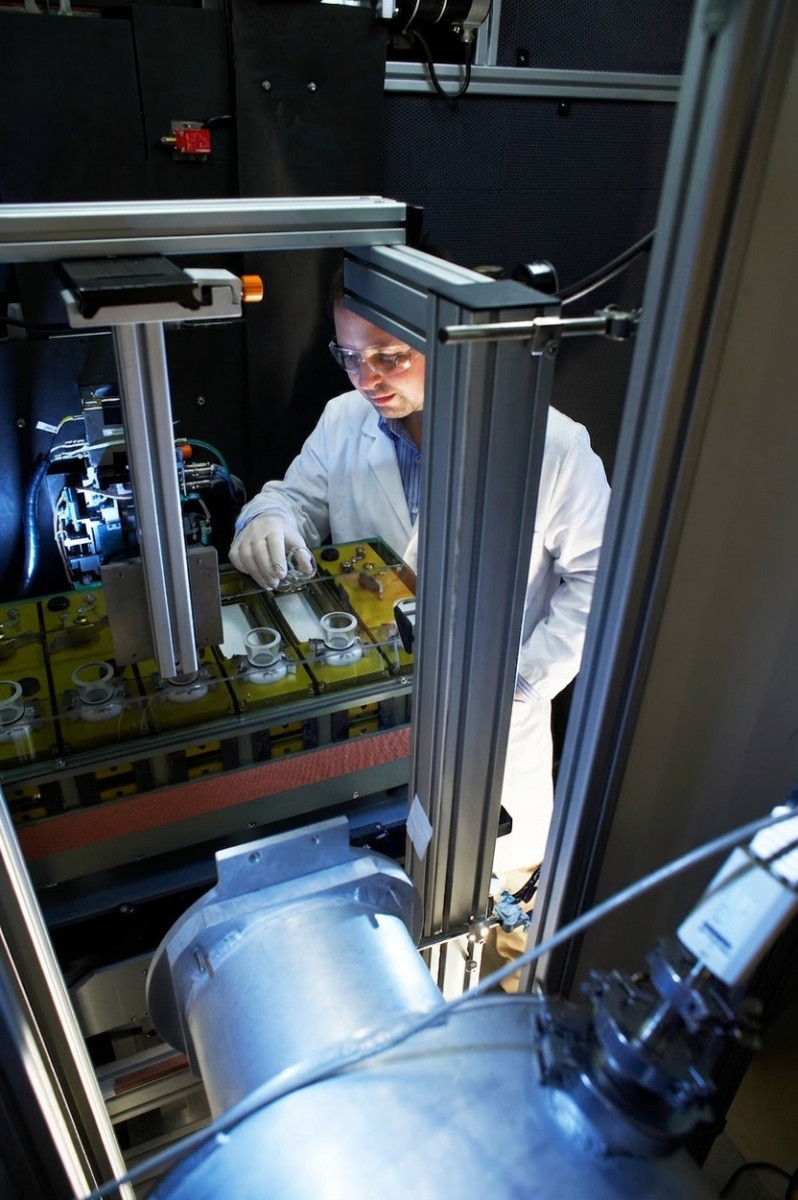
The scientists used an advanced technique called neutron reflectometry at the part-UK-funded Institut Laue-Langevin (ILL) in France, where Dr Campbell was formerly based.
The team demonstrated that this behaviour holds true across multiple ranges of concentration and in very different solution conditions, showing the mechanism is not a rare quirk but a universal feature of fibrinogen when it contacts air.
Principal investigator Dr Campbell explained: "It's never easy challenging an established model of how molecules behave in nature.
鈥淏ut through using the advanced technique neutron reflectometry on the FIGARO instrument at the ILL research facility, we could see the structure of these protein surfaces in more detail than scientists had seen before.
Although lab data recorded in the past was compatible with the concept of a 鈥榮ingle tilting layer鈥� model, our new data show multiple layering as a fundamentally different way of working
鈥淎lthough lab data recorded in the past was compatible with the concept of a 鈥榮ingle tilting layer鈥� model, our new data show multiple layering as a fundamentally different way of working.鈥�
Dr Glenn Coope, a former PhD student at 糖心Vlog官方 but now based at Lund University in Sweden, said: "When the covid-19 pandemic struck, I spent time analysing structural data of how fibrinogen gathered at liquid surfaces while working from home.
鈥淭hen after returning to work at the University, I applied additional experimental methods.
鈥淚t鈥檚 almost like we now have a full circle moment, as our findings may help scientists to understand better the behaviour of fibrinogen in the lungs of patients suffering from ARDS, a condition that tragically claimed so many lives during the pandemic.鈥�
Dr Campbell added: 鈥淥ur discovery sheds new light on how scabs form on the surface of an open wound, where fibrinogen works in a protein鈥憆ich zone to stop bleeding.
鈥淗aving better understanding of the structure of fibrinogen at liquid surfaces can only help in the search for new and better treatments for patients whose wound refuse to heal.鈥�
- The paper Redefining Fibrinogen Self鈥慉ssembly at the Air鈥揥ater Interface: An Intriguing Story with Multiple Layers is published in Journal of the American Chemical Society. DOI
- Other researchers from the University of Manchester and Institut Laue-Langevin contributed to the study