Doctoral Researcher Presents Findings at the European Conference on Machine Learning and Principles and Practice of Knowledge Discovery in Databases
Bahrul Ilmi Nasution, a doctoral researcher in the Department of Social Statistics at 糖心Vlog官方, recently presented his research,听Understanding Latent Flow Models for Tabular Data Synthesis: Targets, Paths, and Sampling, at the European Conference on Machine Learning and Principles and Practice of Knowledge Discovery in Databases (ECML PKDD 2026) in Italy.听
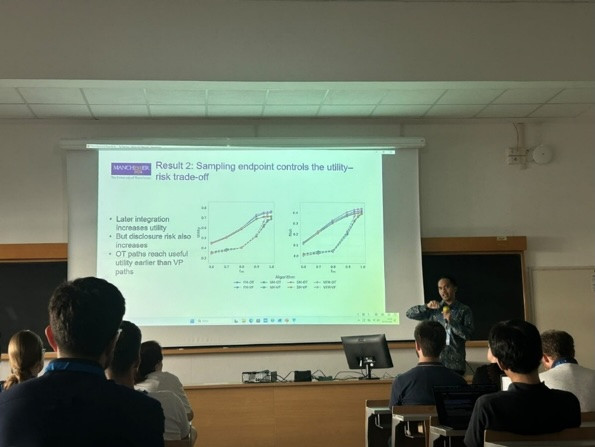
Synthetic social data can help researchers access and analyse information derived from sensitive microdata without directly releasing the original records. However, useful synthetic data must preserve important statistical properties while also limiting disclosure risk and remaining computationally practical. The study investigated latent flow models, a class of continuous-time generative models that transform random noise into synthetic observations. Although different learning approaches - including velocity, score, noise, and posterior matching - can describe the same underlying generative process under ideal theoretical conditions, the paper examined whether they remain equivalent when implemented using finite data, approximate neural networks, numerical solvers, and limited computational budgets.听Across seven tabular datasets, with five censuses among them, the results show that theoretically connected formulations can behave differently in practice. Velocity and posterior matching generally achieve higher statistical utility, while score and noise matching tend to produce more conservative disclosure-risk profiles. The study also demonstrates that probability paths, deterministic or stochastic sampling, numerical solvers, integration endpoints, and sampling budgets can substantially affect the quality of the synthetic data.
The findings provide practical guidance for selecting and configuring latent flow models according to the intended balance between analytical utility, disclosure risk, data fidelity, and computational cost. The full article is available here:https://arxiv.org/abs/2606.20878