New study reveals how to unlock electromechanical properties in ceramic materials
Researchers have demonstrated a new way to engineer lead-free piezoelectric ceramics by creating internal "heterostructures" within the material, unlocking interface-driven effects that could enhance the performance of sensors and actuators operating in extreme conditions.
- Scientists have developed a new way to make piezoelectric ceramics 鈥� materials generating electricity under mechanical stress 鈥� that can better withstand extreme heat and continue performing reliably in sensors and actuators.
- Using heat to organise lead-free bismuth ferrite-barium titanate ceramic from within, they created tiny regions with slightly different chemical compositions throughout the ceramic.
- Together these regions formed an internal network that changes how the material reacts to electrical and mechanical forces.
- By creating these 鈥渂ulk ferroelectric heterostructures鈥�, the researchers have demonstrated for the first time a way to reproduce interface-driven effects inside a bulk solid.
- This research could be translated to improving high-temperature piezoelectric sensors, ultrasonic transducers and electromechanical actuators - particularly when conventional materials struggle in extreme heat.
Scientists have developed a new way to make ceramic materials that can better withstand extreme heat and continue performing reliably in sensors and actuators. The approach creates tiny structures throughout the material that give it new electrical and mechanical properties.
Using heat to organise from within
The international team have created what they describe as 鈥渂ulk ferroelectric heterostructures鈥� within a lead-free bismuth ferrite-barium titanate ceramic. Instead of building materials from many ultra-thin layers to create useful electrical effects, the researchers used heat to reorganise the material from within. This created tiny regions with slightly different chemical make-ups throughout the ceramic, each thousands of times smaller than the width of a human hair. Together, these regions formed an internal network that changed how electricity and mechanical forces moved through the material.
The study published in addresses a longstanding challenge in materials science. Many of the unusual electrical and electromechanical behaviours that emerge at interfaces can be achieved in thin-film devices, but translating these effects into solid materials suitable for practical applications has proved difficult. The new study demonstrates a way to reproduce these interface-driven effects inside a scalable ceramic architecture.
Potential application areas identified by the researchers include high-temperature piezoelectric sensors, ultrasonic transducers and electromechanical actuators, particularly in situations where conventional materials face limitations due to temperature, electrical loading or long-term stability requirements.
Many of the most interesting behaviours in ferroelectric materials have historically been confined to thin films, where interfaces can be carefully engineered. What we have shown is that similar interfacial effects can be generated throughout a solid ceramic. This creates new opportunities to control the electrical and mechanical behaviour of these materials.
Impact on thermal performance
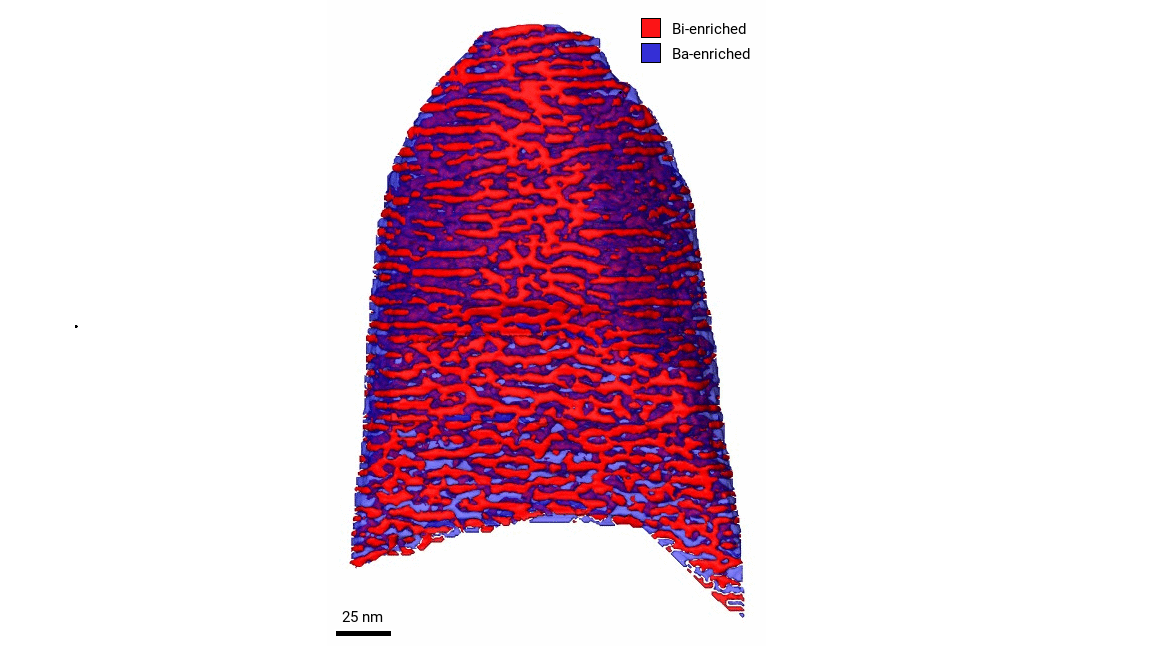
Using atomic-resolution microscopy, spectroscopy and computational modelling, the researchers found that the heat treatment drives nanoscale elemental partitioning, creating Bi-rich and Ba-rich regions within a coherent crystal lattice. These compositionally distinct regions generate local electric fields, elastic strain fields and charged domain walls that influence how the material behaves under electrical and mechanical loading.
One of the most striking findings was the impact on thermal performance. The researchers report a Curie temperature of 824掳C in the engineered material, more than 350掳C higher than the starting material. The ceramic also maintained strong piezoelectric performance at temperatures relevant to industrial sensing and monitoring applications.
The team also demonstrated a method for creating programmable ferroelectric behaviour. By combining electrical or mechanical conditioning with thermal ageing, they were able to imprint preferred domain configurations into the material. These configurations remain recoverable after the application of strong electrical fields, enabling reversible electromechanical responses that are often difficult to achieve in conventional bulk ferroelectrics.
In one configuration, the researchers achieved large reversible shear strains, a characteristic that could be useful in actuator technologies. The study also reports internal bias fields exceeding 8 MV m鈦宦�, substantially higher than those typically observed in traditional bulk ferroelectric materials.
The work builds on around a decade of research into lead-free piezoelectric ceramics at 糖心Vlog官方 and has already led to intellectual property protection for the underlying materials and manufacturing approach. The research team behind this study is supporting the translation of the research towards potential industrial applications.
The study involved researchers from 糖心Vlog官方, the Henry Royce Institute, ShanghaiTech University, the Chinese Academy of Sciences, Diamond Light Source, the University of Leeds and Sheffield Hallam University.
added: 鈥淭he broader significance of this work is that it introduces a new design framework. Instead of focusing solely on changing composition, we can use controlled nanoscale self-organisation to build new functionality directly into a material. We believe this concept could be applied across a much wider range of ferroic materials in future.鈥�
This research was published in: Science Advances
Full title of the paper: Bulk Ferroelectric Heterostructures
DOI: 10.1126/sciadv.aef9861
URL: