Advanced atomic force microscopy techniques
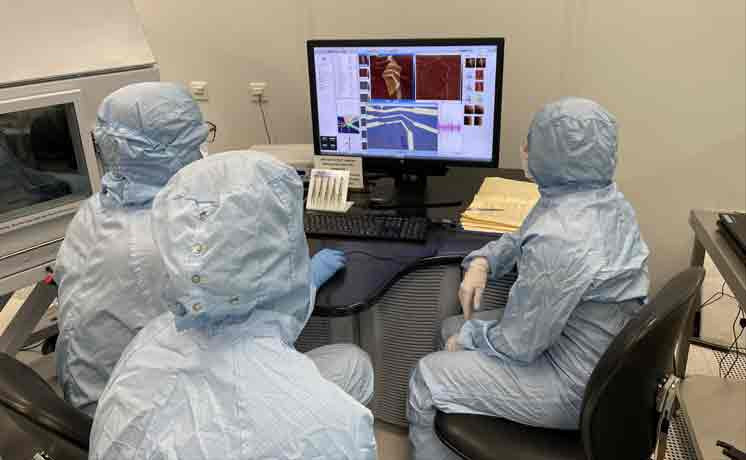
Students from the 2DMoT CDT and other research groups took part in an atomic force microscopy workshop delivered by visiting engineers from Park Systems UK and hosted by the National Graphene Institute.
In the beginning of June, students from the 2DMoT CDT and other groups had the opportunity to attend a workshop on atomic force microscopy (AFM) delivered by visiting engineers from Park Systems UK and hosted at the National Graphene Institute, Manchester.
The workshop introduced the principles and applications of atomic force microscopy before giving students hands-on experience of the Park Systems FX40 system. Through demonstrations and sample analysis, participants explored how advanced AFM techniques can be used to investigate the physical, electronic and magnetic properties of two-dimensional materials.
AFM is a versatile characterization technique that is widely used in the study of 2D materials. With nanometre-scale precision, it is generally used to measure the topography of materials; however, advanced AFM techniques can also be employed in other interesting experiments, to study magnetic and electronic properties, for example.
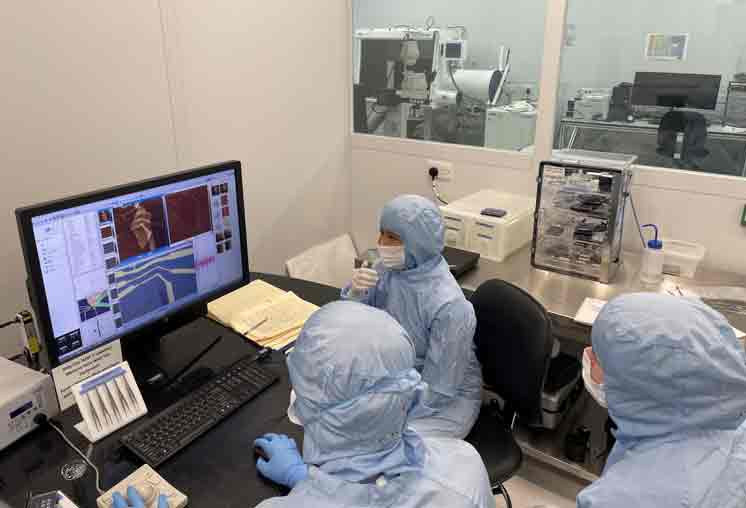
The workshop began with an introduction to the fundamental working principles of AFM, explaining how it probes properties in 2D systems, followed by a hands-on demonstration of Park Systems鈥� new FX40 AFM system and its capabilities. The final part of the workshop involved using this instrument to characterise our samples, demonstrating the system flexibility, allowing to create specific 鈥渞ecipes鈥� that can be tailored according to our experiment requirements.
With the demonstration of the FX40, we were able to understand the capabilities and unique features of this equipment. The most notable feature was the automated nature of this system, allowing for a fully automated loading and switching of AFM tips, something that many of us have spent hours performing the same task manually on the systems that are currently deployed in the labs. Eliminating the risk of dropping or breaking a tip, along with the time saved through automation, is a welcome feature, allowing us to spend more time taking the measurements we need and obtaining reliable results.
The FX40 was also capable of seamlessly switching between magnetic, conductive or piezoelectric and several other measurement modes by simply changing the tip and swapping a few numbers of accessories on the system. This process would normally require us to take our samples to another AFM system, probably located in another lab, making the added convenience and the time savings particularly valuable besides making life easier.
The workshop was very useful for us in our first year of our PhDs. Although we had previously been introduced to AFM, we were not fully aware of the wide range of measurement modes available. It was both interesting and exciting to consider how these AFM measurement techniques could be applied to the study of 2D materials which many of us aim to investigate in our respective experimental projects. Whether the 2D system under study is an insulator (dielectric), conductor, semiconductor, or a magnetic material, the FX40 system offers specialised modes that can probe interesting material properties.
Most of us, came away with new ideas and directions for incorporating the AFM technique into our projects. It was also nice and valuable to have the opportunity, during the lunch break, to discuss the system and our research work with experts in the field in a friendly and informal setting. These discussions provided valuable insights and fresh perspectives on both the system and our own research.
Thank you to Park Systems UK for the engaging demonstration and discussions and thank you to the NGI for hosting the workshop.